
Allen County Criminal Records
A criminal court record is the court clerk's file for a prosecuted case. In Allen County, the main criminal court venue is Allen County District Court, part of the Kansas 31st Judicial District. District court criminal records can include the charging document, appearances, bond orders, counsel entries, motions, plea documents, journal entries, hearing settings, disposition, sentencing, probation violation filings, restitution, fines, costs, and expungement motions if filed.
The arrest side and the court case side should not be merged. A sheriff booking or custody record may show that a person was taken into custody. The criminal court record shows what the State or city filed in court and what happened after filing. The charge-focused path is covered in Allen County arrest records and court charges, while the criminal court file carries the full case history and court outcome.
The Allen County Attorney source appears in the image set because Brandon Cameron's office prosecutes state criminal charges filed in Allen County District Court.
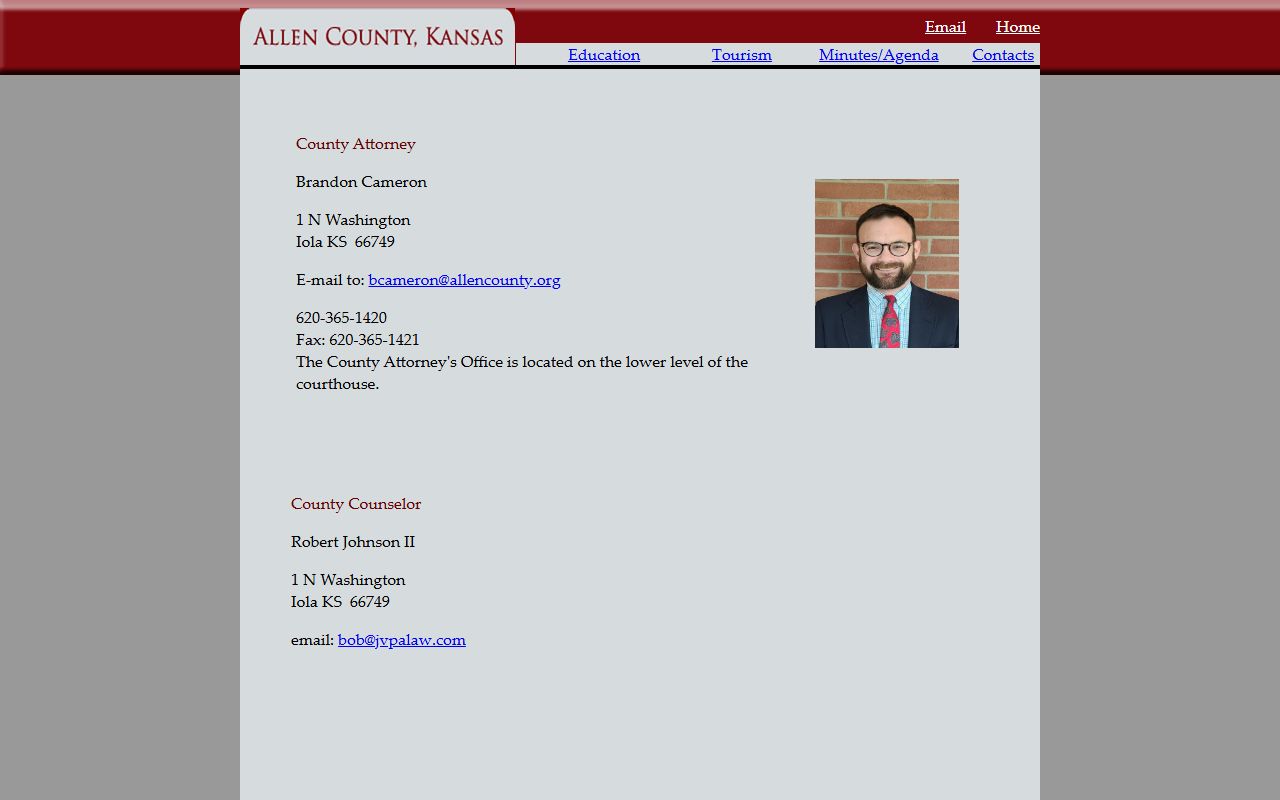
That prosecutor role is central to the move from law-enforcement referral to a filed criminal case.
Search Allen County Criminal Records
Use Kansas CaseSearch for public district court criminal case information. Search by case number when available. Allen County criminal examples include older `YYYY-CR-NNNNNN` numbers and newer `AL-YYYY-CR-NNNNNN` numbers. If the case number is unknown, search by defendant name. The 31st Judicial District Allen County calendar can then help confirm hearing dates, courtroom, judge, attorney, and event type.
- Confirm whether the case is Allen County District Court or Iola Municipal Court.
- Search Kansas CaseSearch by criminal case number or defendant name.
- Read the docket for event type, attorney, judge, courtroom, and visible disposition clues.
- Compare upcoming hearings to the Allen County court calendar and verify by phone if the hearing matters.
- Request certified criminal dispositions from the Clerk of the District Court when a legal copy is needed.
Statewide criminal-history tools are not the same as Allen County criminal court records. The Kansas Bureau of Investigation handles criminal justice records and the KBI registered offender site, while KDOC and KASPER are prison or supervision tools. A court disposition should be checked against the court file when accuracy matters.
Allen County Criminal Case Flow
A court case begins after charges are filed, not simply because an arrest occurred. The local sheriff press release reviewed in the research used a useful phrase: charges were forwarded to the Allen County Attorney's Office for consideration. That shows the gap between arrest, prosecutor review, filed charges, and court disposition.
Case flow: Charges Filed › Arraignment › Pretrial / Motions › Plea or Trial › Disposition › Sentencing
| Stage | What Happens |
|---|---|
| Charges filed | The prosecutor files a complaint, information, citation-based charge, or other charging document with the court. |
| Arraignment | The defendant is advised of the charge and enters or prepares to enter a plea. |
| Pretrial / motions | The court may set status conferences, motion hearings, competency hearings, or other case-management events. |
| Plea or trial | The case may resolve by plea, dismissal, trial verdict, or other disposition. |
| Sentencing | If there is a conviction or plea, the court imposes sentence, probation, fines, costs, or other terms. |
Allen County Criminal Record Fields
The Allen County court calendar showed public criminal examples with prosecutors, defendants, attorneys, court services officers, judges, courtrooms, case numbers, and event types. Common criminal events included sentencing, re-sentencing, review hearing, probation violation judgment-entry review, status conference, motion to withdraw plea, competency hearing, and expungement.
| Field | What It Shows |
|---|---|
| Case number | Older or newer Allen County criminal number, such as `2012-CR-000039` or `AL-2025-CR-000105`. |
| Caption | Usually State of Kansas versus the defendant in district criminal matters. |
| Prosecutor | Allen County Attorney's Office or a named prosecutor when listed. |
| Defense | Private counsel, appointed counsel, or pro se status if shown. |
| Charges | Alleged offenses filed with the court, which may later be amended, reduced, dismissed, or resolved. |
| Disposition | The current or final result, such as plea, verdict, dismissal, diversion-related outcome, or sentencing event. |
| Sentence | Jail or prison term, probation, fine, cost, restitution, or other terms when entered in the file. |
Criminal Charges vs Convictions
A charge is an accusation filed in court. A conviction is a finding or plea that resolves a charge as guilty. Allen County criminal court records can show charges that were later dismissed, amended, reduced, diverted, or resolved through a plea. A court calendar entry alone may not tell the final outcome, so the case file or certified disposition is the better source for final status.
| Charge | Conviction | |
|---|---|---|
| Stage | Filed allegation after prosecutor or city review. | Final guilty result by plea or verdict. |
| Record meaning | Shows what was alleged, not what was proved. | Shows the resolved offense and sentence terms. |
| Allen County example | A case may show motion, review, competency, or expungement events before final outcome. | Sentencing or re-sentencing events point to a conviction or plea outcome. |
The Kansas expungement statute article is part of the criminal court records image set because expungement affects how some Allen County criminal records are later disclosed.
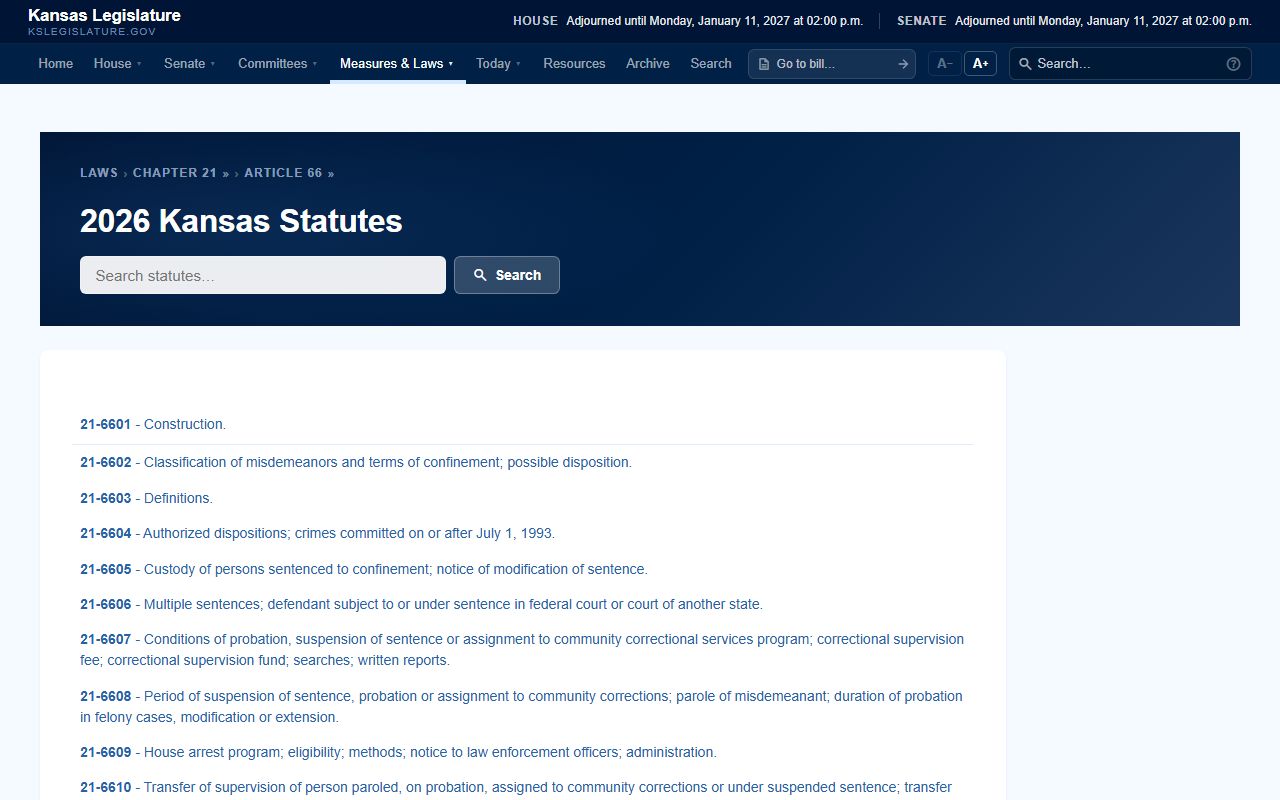
Expungement can change public access, but it does not mean every charge disappears from every authorized criminal justice use.
Sealed vs Expunged Records
Sealing and expungement both limit public access, but they are not the same. Kansas expungement laws allow qualifying people to ask the court to restrict certain convictions, arrest records, diversion agreements, juvenile records, and wrongful-conviction records. A sealed record is hidden from normal public view because of a statute, order, or confidential case type. An expunged record is restricted under the expungement order and disclosed only as law permits.
| Sealed | Expunged | |
|---|---|---|
| Visibility | Not visible to ordinary public users. | Restricted after a qualifying court order. |
| Common source | Juvenile, CINC, protected, or court-ordered confidential matters. | K.S.A. 21-6614 and related Kansas expungement statutes. |
| Allen County impact | Calendar entries may show sealed names or roles. | The clerk and criminal justice agencies follow the expungement order. |
The K.S.A. 38-2209 confidentiality statute is in the image set because child-in-need-of-care records are a key Allen County criminal-adjacent restriction.
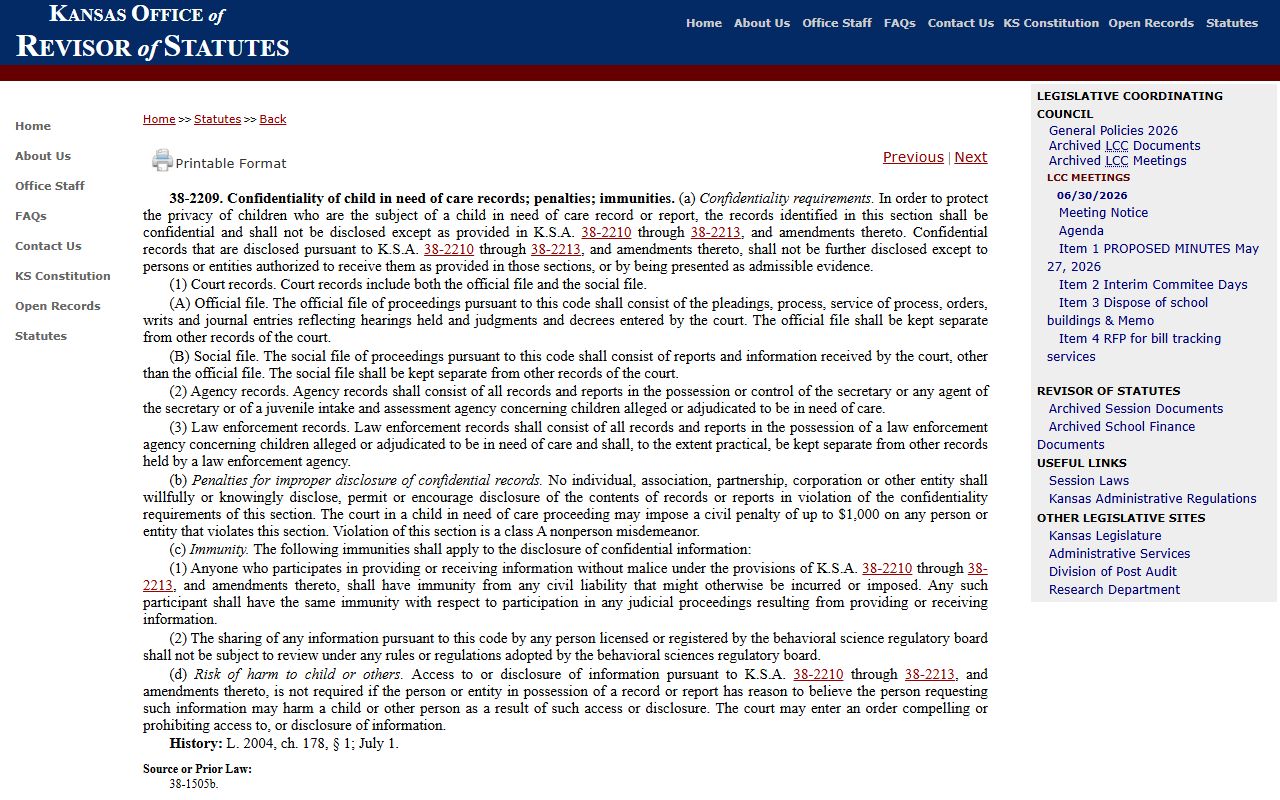
Allen County calendars may show that a juvenile or CINC hearing exists while still shielding identifying information.
Allen County Criminal Access
Public criminal records are governed by Kansas court access rules and public-record laws. Kansas Supreme Court Rule 22 controls electronic access to district court and appellate case records. KORA is the broader Kansas public-records framework. The two work together, but Rule 22 is the key source for what public users can see online in district court systems.
Certified criminal dispositions, older files, and records not visible online should be requested from the Clerk of the District Court. The district court counter is also the route when a public record exists but online access is limited. If the case is municipal, use Iola Municipal Court rather than the district court clerk.
Key access point: Call Allen County District Court at 620-365-1425 before relying on a calendar entry as a final criminal disposition.
The K.S.A. 45-215 source appears in the image set because Kansas public-record law frames access to government records generally.
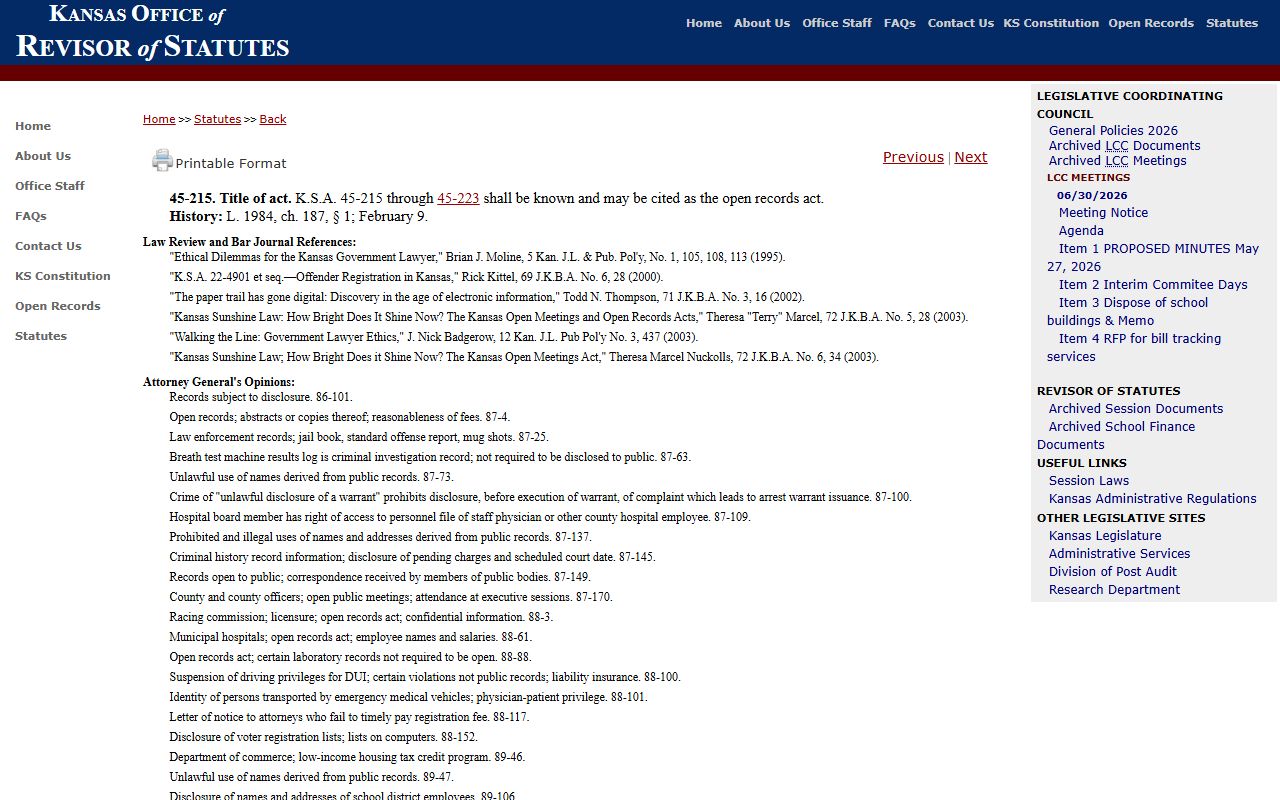
For criminal court documents, that public-record framework must be read with court rules and confidentiality statutes.
Restricted Allen County Criminal Records
Juvenile offender, child-in-need-of-care, sealed, expunged, protection, and some domestic-related records may be restricted. The inspected Allen County calendar displayed sealed fields for juvenile/CINC/dependent information. A public user may see an event without seeing a child's name, party role, guardian ad litem, or other protected detail.
Diversion also affects how a criminal case should be read. The Allen County Attorney has a diversion information and application source, and diversion can resolve a charge without the same meaning as a conviction if the terms are completed. For any employment, housing, licensing, immigration, or legal-rights question, use certified court records or counsel rather than a casual online search result.